Sunday, September 12, 2010

At the drive-in: Streets of Fire


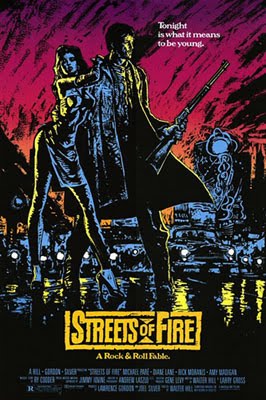
 In the 80’s, singers like Lionel Richie, Whitney Houston, and Michael Jackson were chart toppers. Pop music was at an all time high, and I Can Dream About You could even be included in that category, but it clearly had a Rock n’ Roll influence. Dan Hartman wrote that song and wanted Hall & Oates to record it. He told Daryl Hall that he had a song that would be a perfect fit for them, but they had just released their latest album, so they couldn’t do anything with it. Hartman, having already a famous disco hit Instant Replay, ended up recording it and releasing an album with the same name. What a lot of people don’t know is that I Can Dream About You helped the film Streets of Fire be what it is today for Rock n’ Roll fans.


Streets of Fire was supposed to be a blockbuster film in 1984, with future movie stars Diane Lane, Rick Moranis, and Amy Madigan. It also starred Michael Paré, in the leading male role, but unfortunately, his acting is the downside of the film. I was in my late teens the first time I saw the movie, and loved it. About five years ago, I bought the DVD and watched it again. Paré’s acting is a bit stiff, to say the least. In part, I think that is due to some of the lines, which are filled with wannabe clichés. I thought Paré had the right looks, the right voice, but something is just off. Maybe they could have used someone like Patrick Swayze or Matt Dillon for the part. But then again, if another actor had played the leading role, maybe the film wouldn’t have the cult status it has today. Anyway, the memorable acting was left for Willem Dafoe. He just oozes mean through his pores. He plays the part of Raven, leader of the motorcycle gang called Bombers. During a homecoming show of the now famous singer (19-year-old Diane Lane), Raven kidnaps her. Her ex-boyfriend and former bad boy (Paré) is called upon to come back to town and get her back.


Elizabeth Daily, Diane Lane, and Rick Moranis
Willem Dafoe
Diane Lane as Ellen Aim

Streets of Fire has a mysterious feel to it from the start. The action is divided in two places, the Battery and “the Richmond”, and you can’t really put a finger on the year it takes place. The looks of the cars, store signs, and most of the clothes are clearly 50’s. But when you listen to some of the songs, you know the makers of this film didn’t want a 100% oldies atmosphere.
 
It failed to be a box office hit, but the songs of the film had a great part in making it a home movie success. I for one, never seen it in a movie theater. The first time I saw it was at a friend’s “movie night” get together. A lot of songs were contemporary of the 80’s pop/rock. It stats off with an uptempo Nowhere Fast, which was a hit on radios and gyms at the time, and rolls along with Ry Cooder, the great Rockabilly band The Blasters, and more contemporary rock. The best track for the Doo Wop fan is Countdown to Love, recorded by Greg Phillinganes, and acted out by the fictitious group The Sorels. But for me, the climax of Streets of Fire is when The Sorels sing I Can Dream About You (recorded by Winston Ford for the movie), blending 50’s and 80’s dance moves. That’s when I got hooked on the film. “No more timing each tear that falls from my eyes, I'm not hiding the remedy to cure this old heart of mine”. Yeah, that’s Streets of Fire.

Friday, September 10, 2010

Pause for music: The Blasters


It was the early 80’s, and CDs were still a thing of a not so distant future. Nobody had personal computers and the internet was something nobody even thought would exist someday. So finding out about groups you’ve never heard before was something that would only happen through word of mouth, radio or magazines. If you were really interested in discovering a new sound or group, a good way to do that was to pay a visit to your local used record store. That was something I would do often, and although not everything I found would be a hit among teens my age, I usually discovered an unknown treasure.

Bill Bateman, Gene Taylor, Dave Alvin, John Bazz, and Phil Alvin.

Many of my first LPs, I bought without ever listening to them. I would just take a good look at the sleeve, at the names of the songs, and if there were photos of the group or singers, and they seemed like they played the type of music I liked, I would dig deep into my allowance and take it home. To think of somebody taking a risk like that these days is crazy. But back in those days, there wasn’t much you could do. If the record was used, I could get the store owner to play some of the tracks for me. But if it was sealed, forget it. Nevertheless, I have to say that 80% of the time, I made the right choice.
 
That’s how I bought The Blasters’ Non Fiction (1983) album. The cover screamed “rock n’ roll” to me, and when I looked at the individual photos of the band, the instruments they played, and the track listing, it just seemed like it was the right stuff. Let me get one thing straight before I go on. I was never just about rock and roll. Even though I have over 200 CDs from the 50’s/60’s, I was always very eclectic in terms of music. Actually, I was very much into pop music at the time. But when I first saw this album cover, I was very intrigued. I just had to check what this band was all about.
 
So when I got home, I started listening to the one of the best Rockabilly groups I have ever heard. I can’t say I’m an expert on Rockabilly, but I know the basic stuff: Gene Vincent, Jerry Lee Lewis, (early) Elvis, Stray Cats, Eddie Cochran, Carl Perkins, etc. If I were to describe The Blasters in two words, they would be “contemporary” and “pure”. It’s honest, down to earth Rockabilly.
Lee Allen

The Blasters, which still tours today, was formed in 1979 by brothers Phil (vocals) and Dave Alvin (guitar), along with John Bazz on bass, and Bill Bateman on drums. In the beginning, they were fortunate enough to have tenor saxophone Lee Allen in the band. Before being part of The Blasters, Lee Allen recorded with Fats Domino, Lloyd Price, Little Richard, the Stray Cats, and played three gigs with the Rolling Stones. He was part of the soul of The Blasters until 1994, when he passed away.
 
Since 1986, Dave Alvin has left the band, and some other musicians have come and gone. The Blasters might not be a mainstream group, but they are certainly well known for their one of a kind Rockabilly sound. Their songs were featured in Miami Vice, Six Feet Under, and the band made appearances in Quentin Tarantino’s From Dusk Till Dawn, and the legendary cult movie Streets of Fire.
 

The Blasters in Streets of Fire

If you’re ever interested in purchasing a CD, I recommend Testament: The Complete Slash Recordings. It’s a 2 CD album, with 11 live tracks. It also contains all the songs from the Non Fiction album, and some tracks of the American Music and Trouble Bound CDs. On the clip bellow, you’ll be able to watch Phil Alvin and his trademark grin while singing Red Rose. This is an excerpt of the The Blasters Live – Going Home DVD, recorded in 2003, with the presence of Dave Alvin, back on lead guitar. Watch Phil’s smirk at the beginning of the song. Pure Rockabilly. 


Thursday, September 9, 2010

At the drive-in: American Graffiti


A night in the lives of a group of teenagers of a small American town in 1962. That doesn’t say much for a plot, does it? Nor do words like “culturally significant” or “instant success” come to mind when we read that simple idea for a film. But when the hands and minds of George Lucas and Francis Ford Coppola are involved, you know something good will come out of it.

For those who have never seen American Graffiti, please watch what to me is the best 50’s themed movie ever made. When a movie is selected for preservation by the U.S. Library of Congress, in some sense it has to be worthwhile to watch. Not only that, but take in consideration the actors involved in this film, who were at the beginning of their careers: Harrison Ford, Cindy Williams, Richard Dreyfuss, Ron Howard, and Charles Martin Smith.

Harrison Ford as Bob Falfa

 
One of the most famous cars in movie history: John's '32 Ford.
American Graffiti has all the ingredients that let you to know what the 50’s/60’s were like: a high school dance, the local drive-in, greasers, a favorite DJ, hot rods that you would love to have, and of course, rock n’ roll music. Forget the special effects, the present day big productions. This was film made with $775,000 as a budget (low, for 1973). But it was made by people who knew what they were doing. Even though the making of it had a lot of problems from start (from studios who didn’t want to touch it, to a town who backed out of their contract as a location, after just one day of shooting), it would turn out to be a masterpiece.

Sure, Grease is a great movie as well, but to me it was made in a much more 50’s fantasy world, and the characters were more comical. Don’t get me wrong, I love Grease. But American Graffiti is a down to earth and believable movie. It’s like it was based on the lives of thousands of teens from the 50’s/60’s. Not only that, but much of it evolves around “cruising”, a famous ritual kids back in those days had. Riding around at night in cars on the main road of your town, was for many, the way to flirt, defy other hot rodders for races, or simply look for trouble.
Wolfman Jack

The music selection of this movie was absolutely fantastic for any oldies lover. Not only it has many rock n’ roll “standards”, but the double CD soundtrack also has excerpts of DJ Wolfman Jack broadcasts that were used in American Graffiti. Whoever was lucky enough to buy the LP version, got a real gem. Only on the LP, do you get the extremely rare version of Ain’t That a Shame with female backing vocals. Somebody told me once the famous female vocal group that were credited to have recorded this version with Fats Domino, but I just can’t remember the name right now. If you want to hear this treasure, you can get it here.

I didn’t want to tell too much about the movie in this review, because I really don’t want to spoil the experience for people who are going to watch it for the first time. But there is one special appearance in the film. Flash Cadillac & the Continental Kids sing a famous 50’s hit, At The Hop, in the high school dance scene as Herby and the Heartbeats. That, for itself, is worthwhile watching.

Flash Cadillac and the Continental Kids as Herby and the Heartbeats.


If you’re thinking about buying the DVD, make sure it has The Making of American Graffiti. It contains over an hour of many interviews, not only with George Lucas and Francis Ford Coppola, but also with the whole cast and some of their screen tests. The DVD I have is the collector’s edition, if that helps.

Tuesday, August 31, 2010

The Cadillac of vintage microphones

 
A 1939 Cadillac
When I wrote an older post about the Turner 33 series, I compared vintage microphones to the streamlined designs of 30’s-60’s cars. Well, after doing some research to write about the Shure 55, I found out that the microphone that would become so popular in live performances, radio stations, and famous speeches, was actually inspired by the front grille of the 1939 Cadillac. Like the vintage microphones, those pieces of art on wheels are in a category of their own, providing us with a design that we would never see again. Sure, there are really well designed cars today, but very few make us breathless. At that time, both the streamlined mics and cars flourished during what would probably be their golden age.

In the late 30’s, Shure engineer Benjamin Baumzweiger (who later changed his last name to Bauer), was working on a microphone that would solve feedback problems. Before he created the 55, the unidirectional microphones available were much heavier and had two elements. Bauer’s breakthrough was to become the first single element unidirectional microphone. Shure would call this model the 55 Unidyne (UNI = unidirectional, DYNE = dynamic).
 
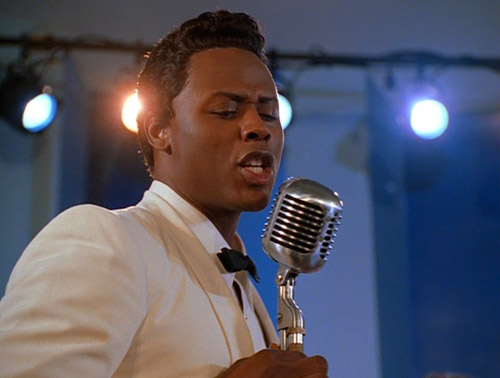
Scene from The Temptations
 
A young Elvis with the Shure 55
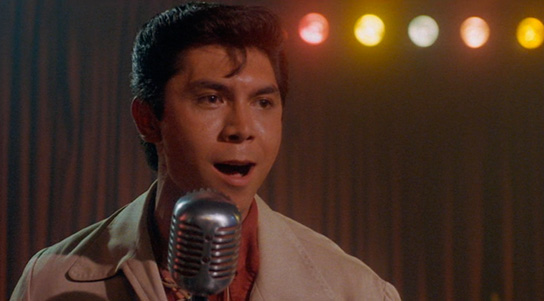
In the beginning, the 55 would have model variations (55A/55B/55C) for different impedances. The one pictured on this post is a model 55, which substituted the need for different models, with a high/medium/low switch on the back. It would also vary in silk color (black, red, or blue). In the 40’s, there would be more two more models, the 555 and 556 shock-mounted microphones. On a curious note, the precursor of the 55S mic is known today as the fat Elvis mic. And no, the 55S, the thinner and smaller version which would make its debut in 1951, is not called the skinny Elvis mic. Nor Elvis on a diet.
 
 
Scene from La Bamba
 
Up to this day, the 55 is the most recognizable microphone in the world. Throughout all these years, it captured the voices of so many different people in such different areas, like: Elvis Presley, Indira Gandhi, Ella Fitzgerald, Billie Holiday, General Eisenhower, Eva Peron, Sarah Vaughan, Frank Sinatra, Groucho Marx, Harry Truman, and was even present at the signing of Japan’s surrender at the end of World War II. The DS rarity scale: 8.5/10.

A promotional photo of Walk the Line

Friday, August 27, 2010

The father of Rock and Roll

Until the late 40’s, probably the type of music most heard on radios came from big bands such as Glenn Miller’s, Benny Goodman’s, Harry James’, Sammy Kaye’s, and famous crooners. When Rock and Roll exploded, so did the amount of vocal groups trying to make it to the top. Groups would be formed in schools, churches, or even street corners. Since that time, radio DJs represented a strong influence on who would hit it big, and who wouldn’t. Although it’s known that some DJs were paid off to play certain records, which would probably help the groups to get more airtime and turn into a household name, I’m pretty sure a song wouldn’t last long if it wasn’t any good. 

Alan Freed, a.k.a. Moondog, was the most famous DJ of that time. He got his artistic name from the New York street musician Louis Hardin, who had an instrumental song called Moondog Symphony, and was known by the same name. (Freed would later lose the right to use the name in a lawsuit Hardin accused him of using his nickname and song without permission). Nevertheless, Alan Freed is known to be the “father” of Rock and Roll, because he was the first to coin the name “Rock and Roll” on the radio, and helped categorize it as a genre of music.

In the late 40’s, while working at a radio station, Freed met Leo Mintz, who was a record store owner in Cleveland. At that time, Mintz told Freed how there was an increase in interest for R&B records. Some years later, Mintz proposed to WJW station to buy airtime for Freed to play R&B records. That would be the beginning of Freed’s success, and probably the start of a more hip and energetic way for DJs to direct themselves at the younger crowd. He was also responsible for promoting the first Rock and Roll concert. The Moondog Coronation Ball was to be held in March 21, 1952, including a five-act show. Due to overcrowding, it had to be shut down. After this happened, Alan Freed’s popularity went over the roof.


Eventually, he moved to New York and expanded his fame all the way to Europe, for originating the Rock and Roll craze, as Life magazine would put it. He appeared in 5 movies in a three year period: Rock Around the Clock, Rock, Rock, Rock, Mr. Rock and Roll, Don’t Knock the Rock, and Go Johnny Go! He also recorded segments for Radio Luxembourg, and also had his own TV show, The Big Beat. What seems almost impossible to believe these days, The Big Beat was canceled after Frankie Lymon of Frankie Lymon and the Teenagers was seen dancing with a white girl.

What was to be a career that was meant to last way beyond the coming of new genres, ended in the late 50’s, when Alan Freed was rightfully accused of receiving money from record companies to play certain records (known at the time as payola). He lost his job at WINS, and in 1962 received a fine and a suspended sentence for two charges of commercial bribery. The law might not have been harsh, but the notoriety of the scandal was. His reputation was stained forever, and east coast radio stations wouldn’t touch him. He ended up working for KDAY-AM on the west coast, which didn’t let him promote any more Rock and Roll stage shows. From there, Freed did a two month stint on a Miami radio station. He died at 43, in 1965, from complications derived from alcoholism.

If you want to hear the type of shows Alan Freed hosted in his prime, I recommend the Rock ‘n’ Roll Radio CD. It’s a compilation of live radio broadcasts on CBS in 1956, with song introductions by Freed. Besides the Count Basie Orchestra, you will also hear Frankie Lymon and the Teenagers, The Drifters, Otis Williams and the Charms, The Cleftones, The Cadillacs, The Chordettes, Ivory Joe Hunter, Gene Vincent, La Verne Baker, Etta James, The Platters, Clyde McPhatter, Chuck Berry, The Penguins, and Bill Haley and the Comets. It’s a pretty rare CD, but I found this link on the web.